
EraHost – Free Domain, Cheap Hosting!


 USD - United States Dollar
 EUR - Euro
 GBP - British Pound
 CAD - Canadian Dollar
 CHF - Swiss Franc
 JPY - Japanese Yen
 AUD - Australian Dollar
 TRY - Turkish Lira
 CNY - Chinese Yuan
 INR - Indian Rupee
 UAH - Ukrainian Hryvnia
 AED - United Arab Emirat...United Arab Emirates Dirham
 AMD - Armenian Dram
 AOA - Angolan Kwanza
 ARS - Argentina Peso
 AWG - Aruba Guilder
 AZN - Azerbaijanian Mana...Azerbaijanian Manat
 BAM - Bosnian Convertibl...Bosnian Convertible Marka
 BDT - Bangladesh Taka
 BGN - Bulgarian Lev
 BHD - Bahraini Dinar
 BIF - Burundian Franc
 BMD - Bermudian Dollar
 BND - Brunei Dollar
 BOB - Bolivian Boliviano
 BRL - Brazilian Real
 BSD - Bahamian Dollar
 BTN - Bhutanese Ngultrum
 BWP - Botswana Pula
 BZD - Belize Dollar
 CLP - Chilean Peso
 CRC - Costa Rican Colon
 CVE - Cape Verdean Escud...Cape Verdean Escudo
 CZK - Czech Koruna
 DJF - Djiboutian Franc
 DKK - Danish Krone
 DOP - Dominican Peso
 DZD - Algerian Dinar
 EGP - Egyptian Pound
 ETB - Ethiopian Birr
 FJD - Fijian Dollar
 FKP - Falkland Island Po...Falkland Island Pound
 GEL - Georgian Lari
 GGP - Guernsey Pound
 GHS - Ghanaian Cedi
 GMD - Gambian Dalasi
 GTQ - Guatemalan Quetzal
 GYD - Guyanese Dollar
 HKD - Hong Kong Dollar
 HNL - Honduran Lempira
 HRK - Croatian Kuna
 HUF - Hungarian Forint
 ILS - Israeli New Shekel
 IMP - Isle of Man Pound
 ISK - Icelandic Krona
 JEP - Jersey Pound
 KES - Kenyan Shilling
 KGS - Kyrgystani Som
 KMF - Comorian Franc
 KRW - South Korean Won
 KWD - Kuwaiti Dinar
 KZT - Kazakhstani Tenge
 LAK - Lao Kip
 LKR - Sri Lankan Rupee
 LRD - Liberian Dollar
 LSL - Lesotho Loti
 LTL - Lithuanian Litas
 LVL - Latvian Lats
 MAD - Moroccan Dirham
 MDL - Moldovan Leu
 MKD - Macedonian Denar
 MNT - Mongolian Tugrik
 MOP - Macanese Pataca
 MRO - Mauritanian Ouguiy...Mauritanian Ouguiya
 MUR - Mauritian Rupee
 MVR - Maldivian Rufiyaa
 MXN - Mexican Peso
 MYR - Malaysian Ringgit
 MZN - Mozambican Metical
 NAD - Namibian Dollar
 NIO - Nicaraguan Cordoba...Nicaraguan Cordoba Oro
 NOK - Norwegian Krone
 NPR - Nepalese Rupee
 NZD - New Zealand Dollar
 OMR - Omani Rial
 PEN - Peruvian Nuevo Sol
 PGK - Papua New Guinean...Papua New Guinean Kina
 PKR - Pakistani Rupee
 PLN - Polish Zloty
 PYG - Paraguayan Guarani
 QAR - Qatari Riyal
 RON - Romanian New Leu
 RSD - Serbian Dinar
 RWF - Rwandan Franc
 SAR - Saudi Riyal
 SBD - Solomon Islands Do...Solomon Islands Dollar
 SCR - Seychellois Rupee
 SEK - Swedish Krona
 SGD - Singapore Dollar
 SHP - St. Helena Pound
 SRD - Surinamese Dollar
 SVC - Salvadoran Colon
 SZL - Swazi Lilangeni
 THB - Thai Baht
 TJS - Tajikistani Somoni
 TMT - Turkmenistani Mana...Turkmenistani Manat
 TND - Tunisian Dinar
 TOP - Tongan Pa`anga
 TWD - New Taiwan Dollar
 UYU - Uruguayan Peso
 WST - Samoan Tala
 ZMW - Zambian Kwacha
 › Blog
› Fix Webmaster Has Forbidden Access Error
› Blog
› Fix Webmaster Has Forbidden Access Error
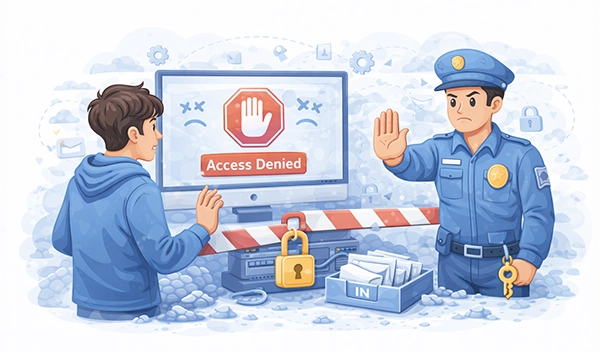
The error "The webmaster has forbidden your access to this site" usually occurs due to server-side restrictions that prevent access to a website. This can happen for several reasons, including IP blocking, incorrect .htaccess rules, security plugins, or firewall restrictions.
The website may have blocked your IP address using .htaccess, a firewall, or a security plugin.
# Using curl
curl -s ifconfig.me

# Using wget
wget -qO- ifconfig.me

# Using dig (shows DNS resolver IP)
dig +short myip.opendns.com @resolver1.opendns.com
You can also check your IP at https://whatismyipaddress.com/.
sudo nano /home/user/public_html/.htaccessLook for lines that block specific IP addresses:
# Apache 2.2 syntax
Deny from 192.168.1.100
Deny from 123.45.67.89

# Apache 2.4 syntax
Require not ip 192.168.1.100
Require not ip 123.45.67.89
If your IP appears in these lines, remove it or comment it out:
# Deny from 192.168.1.100  # Commented out
# Require not ip 192.168.1.100# List all iptables rules
sudo iptables -L -n
# Search for your IP
sudo iptables -L -n | grep YOUR.IP.ADDRESS
# If blocked, remove the rule
sudo iptables -D INPUT -s YOUR.IP.ADDRESS -j DROP
# Save iptables rules (Ubuntu/Debian)
sudo iptables-save > /etc/iptables/rules.v4# Check if IP is blocked in CSF
sudo csf -g YOUR.IP.ADDRESS
# Remove IP from deny list
sudo csf -dr YOUR.IP.ADDRESS
# Reload CSF rules
sudo csf -r
# Check temporary blocks
sudo csf -tAfter making changes, try accessing the site again.
A misconfigured .htaccess file can deny access to all users or specific user agents.
sudo nano /home/user/public_html/.htaccess# Apache 2.2 - Denies all access
Order Deny,Allow
Deny from all
# Apache 2.4 - Denies all access
Require all denied
# Blocks based on user agent
RewriteEngine On
RewriteCond %{HTTP_USER_AGENT} (badbot|evilbot|scraper) [NC]
RewriteRule .* - [F,L]
# Blocks based on referrer
RewriteCond %{HTTP_REFERER} spamdomain\.com [NC]
RewriteRule .* - [F,L]
# Blocks based on IP range
Deny from 192.168.0.0/16
Require not ip 10.0.0.0/8Temporarily rename the .htaccess file to test if it's causing the issue:
sudo mv /home/user/public_html/.htaccess /home/user/public_html/.htaccess_backupThen try accessing the site. If it works, the problem is in your .htaccess file.
# For Apache
sudo systemctl restart apache2

# For Nginx
sudo systemctl restart nginxSecurity plugins (like Wordfence, Sucuri, iThemes Security, All In One WP Security) can block access based on various criteria.
# Rename the plugin folder (disables it)
sudo mv /home/user/public_html/wp-content/plugins/wordfence /home/user/public_html/wp-content/plugins/wordfence_disabled

# For multiple security plugins
sudo mv /home/user/public_html/wp-content/plugins/sucuri-scanner /home/user/public_html/wp-content/plugins/sucuri-scanner_disabled
sudo mv /home/user/public_html/wp-content/plugins/better-wp-security /home/user/public_html/wp-content/plugins/better-wp-security_disabled
sudo mv /home/user/public_html/wp-content/plugins/all-in-one-wp-security-and-firewall /home/user/public_html/wp-content/plugins/all-in-one-wp-security_disabled-- Run in phpMyAdmin or MySQL command line
UPDATE wp_options SET option_value = '' WHERE option_name = 'active_plugins';Some plugins create configuration files that might block access:
# Wordfence configuration
sudo ls -la /home/user/public_html/wp-content/wflogs/

# Check for blocked IPs
sudo cat /home/user/public_html/wp-content/wflogs/config.php 2>/dev/null | grep block
After disabling plugins, try accessing the site again. If it works, reconfigure the security plugin with less restrictive settings.
If the issue persists, check the main server configuration files.
# Ubuntu/Debian
sudo nano /etc/apache2/apache2.conf
sudo nano /etc/apache2/sites-available/000-default.conf

# CentOS/RHEL/Fedora
sudo nano /etc/httpd/conf/httpd.conf
sudo nano /etc/httpd/conf.d/*.conf
Ensure the directory configuration allows access:
# Apache 2.4 syntax (should look like this)
<Directory "/var/www/html">
    Options Indexes FollowSymLinks
    AllowOverride All
    Require all granted
</Directory># Main configuration
sudo nano /etc/nginx/nginx.conf
# Site-specific configuration
sudo nano /etc/nginx/sites-available/default
sudo nano /etc/nginx/conf.d/*.confLook for deny directives:
# Blocks all access
deny all;

# Blocks specific IPs
deny 192.168.1.100;

# Location block that might be restrictive
location /admin/ {
    deny all;
}# For Apache
sudo systemctl restart apache2
sudo apache2ctl configtest # Test configuration first
# For Nginx
sudo nginx -t # Test configuration first
sudo systemctl restart nginxIf the above steps don't work, try these additional approaches:
ipconfig /flushdns (Windows) or sudo systemd-resolve --flush-caches (Linux)| Issue | Fix | Where to Check |
|---|---|---|
| IP Blocked | Remove from .htaccess, Firewall (iptables, CSF) | .htaccess, csf -g IP, iptables -L |
| Restrictive .htaccess rules | Remove Deny from all or Require all denied |
/home/user/public_html/.htaccess |
| Security Plugin Block | Disable Wordfence, Sucuri, iThemes Security | wp-content/plugins/ directory |
| Server Configuration | Check apache2.conf or nginx.conf |
/etc/apache2/ or /etc/nginx/ |
| Cloudflare/ CDN Block | Check security settings in CDN dashboard | Cloudflare Dashboard > Security |
| Browser Issues | Clear cache, try incognito, disable extensions | Browser settings |
| Network Issues | Try VPN, mobile data, different network | Network configuration |
By systematically checking each potential cause, you should be able to identify and fix the "webmaster has forbidden your access" error and restore access to the website!







 Telegram Bot

 USD - United States Dollar
 EUR - Euro
 GBP - British Pound
 CAD - Canadian Dollar
 CHF - Swiss Franc
 JPY - Japanese Yen
 AUD - Australian Dollar
 RUB - Russian Ruble
 TRY - Turkish Lira
 CNY - Chinese Yuan
 INR - Indian Rupee
 UAH - Ukrainian Hryvnia