


 USD - United States Dollar
 EUR - Euro
 GBP - British Pound
 CAD - Canadian Dollar
 CHF - Swiss Franc
 JPY - Japanese Yen
 AUD - Australian Dollar
 TRY - Turkish Lira
 CNY - Chinese Yuan
 INR - Indian Rupee
 UAH - Ukrainian Hryvnia
 AED - United Arab Emirat...
 AMD - Armenian Dram
 AOA - Angolan Kwanza
 ARS - Argentina Peso
 AWG - Aruba Guilder
 AZN - Azerbaijanian Mana...
 BAM - Bosnian Convertibl...
 BDT - Bangladesh Taka
 BGN - Bulgarian Lev
 BHD - Bahraini Dinar
 BIF - Burundian Franc
 BMD - Bermudian Dollar
 BND - Brunei Dollar
 BOB - Bolivian Boliviano
 BRL - Brazilian Real
 BSD - Bahamian Dollar
 BTN - Bhutanese Ngultrum
 BWP - Botswana Pula
 BZD - Belize Dollar
 CLP - Chilean Peso
 CRC - Costa Rican Colon
 CVE - Cape Verdean Escud...
 CZK - Czech Koruna
 DJF - Djiboutian Franc
 DKK - Danish Krone
 DOP - Dominican Peso
 DZD - Algerian Dinar
 EGP - Egyptian Pound
 ETB - Ethiopian Birr
 FJD - Fijian Dollar
 FKP - Falkland Island Po...
 GEL - Georgian Lari
 GGP - Guernsey Pound
 GHS - Ghanaian Cedi
 GMD - Gambian Dalasi
 GTQ - Guatemalan Quetzal
 GYD - Guyanese Dollar
 HKD - Hong Kong Dollar
 HNL - Honduran Lempira
 HRK - Croatian Kuna
 HUF - Hungarian Forint
 ILS - Israeli New Shekel
 IMP - Isle of Man Pound
 ISK - Icelandic Krona
 JEP - Jersey Pound
 KES - Kenyan Shilling
 KGS - Kyrgystani Som
 KMF - Comorian Franc
 KRW - South Korean Won
 KWD - Kuwaiti Dinar
 KZT - Kazakhstani Tenge
 LAK - Lao Kip
 LKR - Sri Lankan Rupee
 LRD - Liberian Dollar
 LSL - Lesotho Loti
 LTL - Lithuanian Litas
 LVL - Latvian Lats
 MAD - Moroccan Dirham
 MDL - Moldovan Leu
 MKD - Macedonian Denar
 MNT - Mongolian Tugrik
 MOP - Macanese Pataca
 MRO - Mauritanian Ouguiy...
 MUR - Mauritian Rupee
 MVR - Maldivian Rufiyaa
 MXN - Mexican Peso
 MYR - Malaysian Ringgit
 MZN - Mozambican Metical
 NAD - Namibian Dollar
 NIO - Nicaraguan Cordoba...
 NOK - Norwegian Krone
 NPR - Nepalese Rupee
 NZD - New Zealand Dollar
 OMR - Omani Rial
 PEN - Peruvian Nuevo Sol
 PGK - Papua New Guinean...
 PKR - Pakistani Rupee
 PLN - Polish Zloty
 PYG - Paraguayan Guarani
 QAR - Qatari Riyal
 RON - Romanian New Leu
 RSD - Serbian Dinar
 RWF - Rwandan Franc
 SAR - Saudi Riyal
 SBD - Solomon Islands Do...
 SCR - Seychellois Rupee
 SEK - Swedish Krona
 SGD - Singapore Dollar
 SHP - St. Helena Pound
 SRD - Surinamese Dollar
 SVC - Salvadoran Colon
 SZL - Swazi Lilangeni
 THB - Thai Baht
 TJS - Tajikistani Somoni
 TMT - Turkmenistani Mana...
 TND - Tunisian Dinar
 TOP - Tongan Pa`anga
 TWD - New Taiwan Dollar
 UYU - Uruguayan Peso
 WST - Samoan Tala
 ZMW - Zambian Kwacha


 Telegram Bot

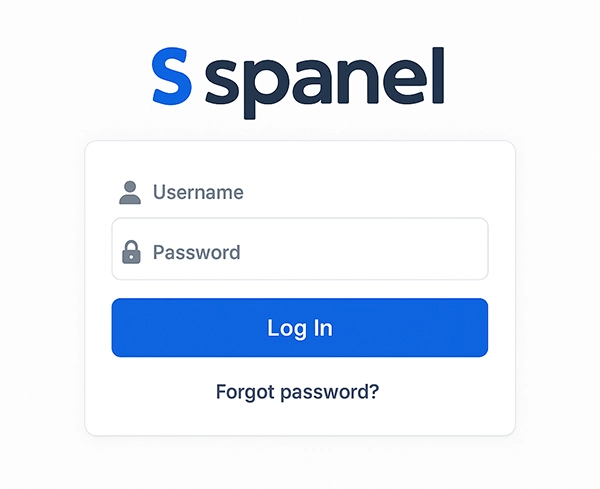
If you're using sPanel to manage your VPS hosting, you need to log in to control websites, emails, databases, and server settings. This comprehensive guide covers all sPanel login methods and troubleshooting steps.
What is sPanel? sPanel is a free alternative to cPanel developed by ScalaHosting, specifically optimized for VPS and cloud hosting environments. It provides a user-friendly interface for managing all aspects of your hosting.
1 How to Log In to sPanel as a User
This method is for managing websites, domains, emails, databases, and other user-level functions.
Step-by-Step User Login
- Open your web browser (Chrome, Firefox, Safari, Edge, etc.)
- Navigate to sPanel login page using one of these URLs:
https://yourdomain.com/spanel
or
https://your-server-ip:2083 - Enter your credentials:
- Username: Provided by your hosting provider (usually your domain or custom username)
- Password: The password set during account creation or provided by your host
- Click "Log In" or press Enter
User Login URLs Explained
| URL Format | When to Use | Notes |
|---|---|---|
https://yourdomain.com/spanel |
When your domain DNS is properly configured | Most common method for end-users |
https://your-server-ip:2083 |
When domain DNS is not yet propagated | Use server IP provided by hosting company |
http://yourdomain.com:2082 |
When HTTPS is not working | Non-SSL connection (less secure) |
https://yourdomain.com:2083 |
Alternative SSL access | Direct port access if /spanel path doesn't work |
SSL Certificate Warning: On first login, you may see a security warning because sPanel uses a self-signed SSL certificate. You can safely proceed by clicking "Advanced" and "Proceed to [site]". For permanent fix, install a proper SSL certificate.
What You Can Do in User Dashboard
- Manage websites and domains
- Create and manage email accounts
- Manage MySQL databases
- Upload files via File Manager
- Install SSL certificates
- Configure backups
- Monitor resource usage
- Access webmail
2 Log In as Admin (Root Access)
This method provides full server-level control and administration capabilities.
Step-by-Step Admin Login
- Open your web browser
- Navigate to sPanel admin interface:
https://your-server-ip:2087
- Enter admin credentials:
- Username: root (or admin username provided by host)
- Password: Root/Admin password (provided during server setup)
- Click "Log In"
Security Warning: The admin interface provides complete control over your server. Protect these credentials carefully and only use when necessary for server administration tasks.
Admin Login URLs
| URL Format | Purpose | Security Level |
|---|---|---|
https://your-server-ip:2087 |
Primary admin interface | High (SSL encrypted) |
http://your-server-ip:2086 |
Non-SSL admin access | Medium (not recommended) |
https://yourdomain.com:2087 |
Admin via domain name | High (requires proper DNS) |
What You Can Do in Admin Dashboard
- Create and manage user accounts
- Monitor server resource usage
- Configure server-wide settings
- Manage server security and firewall
- Install and update software packages
- Configure web server settings (Apache/LiteSpeed/Nginx)
- Manage DNS zones and records
- View system logs and audit trails
- Configure backup policies
- Manage PHP versions and extensions
3 Forgot Your sPanel Password?
If you can't remember your sPanel password, here are several recovery methods:
Method 1: Reset via sPanel Login Page
- Go to the sPanel login page (
https://yourdomain.com/spanel) - Click the "Forgot Password?" link below the login form
- Enter your registered email address
- Check your email for a password reset link
- Click the link in the email and follow instructions to set a new password
Method 2: Reset via Admin Interface (If you have another admin account)
- Log in to sPanel admin interface (
https://your-server-ip:2087) - Navigate to "User Management" or "Accounts"
- Find the user account needing password reset
- Click "Change Password" or similar option
- Set a new password and save changes
Method 3: Reset via SSH (For VPS Admins with root access)
If you have SSH access to your server, you can reset any user's password:
# Connect to your server via SSH
ssh root@your-server-ip
# Reset password for specific user
passwd username
# Example: Reset password for user "john"
passwd john
# You'll be prompted to enter new password twice
ssh root@your-server-ip
# Reset password for specific user
passwd username
# Example: Reset password for user "john"
passwd john
# You'll be prompted to enter new password twice
Method 4: Reset via sPanel Command Line (If SSH access available)
# Use sPanel's password reset utility
spanel-reset-password username
# Example
spanel-reset-password john
# Follow prompts to set new password
spanel-reset-password username
# Example
spanel-reset-password john
# Follow prompts to set new password
Password Requirements: sPanel typically requires strong passwords with minimum 8 characters, including uppercase, lowercase, numbers, and special characters.
4 Alternative SSH Access Methods
For advanced users, SSH provides direct server access without the web interface:
SSH Login for Server Management
# Basic SSH connection
ssh username@your-server-ip
# With specific port (if not default 22)
ssh username@your-server-ip -p 2222
# Root SSH access (if enabled)
ssh root@your-server-ip
ssh username@your-server-ip
# With specific port (if not default 22)
ssh username@your-server-ip -p 2222
# Root SSH access (if enabled)
ssh root@your-server-ip
Common SSH Commands for sPanel Management
# Check sPanel service status
systemctl status spanel
# Restart sPanel service
systemctl restart spanel
# View sPanel logs
tail -f /var/log/spanel/error.log
# Check disk space
df -h
# Check memory usage
free -m
systemctl status spanel
# Restart sPanel service
systemctl restart spanel
# View sPanel logs
tail -f /var/log/spanel/error.log
# Check disk space
df -h
# Check memory usage
free -m
SSH Security: Always use SSH keys instead of passwords for better security. Disable root SSH login if not absolutely necessary.
5 Troubleshooting sPanel Login Issues
| Issue | Possible Causes | Solutions |
|---|---|---|
| Cannot access sPanel | Wrong URL, DNS not propagated, server offline | Use https://your-server-ip:2083Check server status with hosting provider Verify DNS settings |
| Wrong password error | Incorrect password, caps lock on, account locked | Reset password via "Forgot Password" Check caps lock key Contact admin if account locked |
| SSL/TLS certificate error | Self-signed certificate, expired certificate | Click "Advanced" > "Proceed anyway" Install proper SSL certificate Use HTTP on port 2082 temporarily |
| Firewall blocking access | Ports 2083/2087 blocked, IP restricted | Check firewall rules Allow ports 2083, 2087, 2082, 2086 Check if IP is whitelisted |
| Connection timeout | Server overloaded, network issues, sPanel service down | Check server resource usage Restart sPanel service via SSH Contact hosting support |
| Blank/white screen after login | PHP errors, insufficient memory, corrupt session | Clear browser cache and cookies Try different browser Check PHP error logs |
| "Access Denied" message | IP restriction, account suspended, permission issues | Check if your IP is allowed Verify account status with host Check user permissions |
Advanced Troubleshooting Commands
# Check if sPanel service is running
systemctl status spanel
# Restart sPanel service
systemctl restart spanel
# Check web server status
systemctl status apache2
systemctl status litespeed
# Check firewall status
ufw status
firewall-cmd --list-all
# Check open ports
netstat -tulpn | grep 2083
netstat -tulpn | grep 2087
systemctl status spanel
# Restart sPanel service
systemctl restart spanel
# Check web server status
systemctl status apache2
systemctl status litespeed
# Check firewall status
ufw status
firewall-cmd --list-all
# Check open ports
netstat -tulpn | grep 2083
netstat -tulpn | grep 2087
6 Security Best Practices for sPanel Login
Essential Security Measures:
- Use Strong Passwords:
- Minimum 12 characters
- Mix of uppercase, lowercase, numbers, symbols
- No dictionary words or personal information
- Enable Two-Factor Authentication (2FA):
- If sPanel supports 2FA, enable it immediately
- Use authenticator apps (Google Authenticator, Authy)
- Restrict Access by IP:
- Configure firewall to allow only your IP addresses
- Use VPN for remote access from untrusted networks
- Regularly Update Passwords:
- Change passwords every 90 days
- Don't reuse passwords across different services
- Monitor Login Activity:
- Regularly check access logs
- Set up login notifications if available
- Use HTTPS Only:
- Always use
https://nothttp:// - Install valid SSL certificate for your domain
- Always use
- Limit Admin Access:
- Only use admin login when necessary
- Create separate user accounts for daily tasks
7 Quick Reference Guide
| Task | URL / Command | Purpose |
|---|---|---|
| User Login | https://yourdomain.com/spanelhttps://server-ip:2083 |
Website, email, database management |
| Admin Login | https://server-ip:2087 |
Server administration and configuration |
| Non-SSL User Login | http://server-ip:2082 |
Alternative when SSL has issues |
| Non-SSL Admin Login | http://server-ip:2086 |
Admin access without SSL (not recommended) |
| Password Reset (Web) | Click "Forgot Password?" on login page | Reset via email link |
| Password Reset (SSH) | passwd username |
Reset via command line |
| Check Service Status | systemctl status spanel |
Verify sPanel is running |
| Restart Service | systemctl restart spanel |
Restart sPanel after configuration changes |
| Webmail Access | https://yourdomain.com/webmail |
Access email via browser |
| SSH Access | ssh username@server-ip |
Command line server access |
Bookmark Tip: Save your sPanel login URL as a bookmark in your browser for quick access. Use a password manager to securely store your credentials.
Now you can access sPanel easily and securely manage your hosting environment!




 USD - United States Dollar
 EUR - Euro
 GBP - British Pound
 CAD - Canadian Dollar
 CHF - Swiss Franc
 JPY - Japanese Yen
 AUD - Australian Dollar
 RUB - Russian Ruble
 TRY - Turkish Lira
 CNY - Chinese Yuan
 INR - Indian Rupee
 UAH - Ukrainian Hryvnia