
EraHost – Free Domain, Cheap Hosting!


 USD - United States Dollar
 EUR - Euro
 GBP - British Pound
 CAD - Canadian Dollar
 CHF - Swiss Franc
 JPY - Japanese Yen
 AUD - Australian Dollar
 TRY - Turkish Lira
 CNY - Chinese Yuan
 INR - Indian Rupee
 UAH - Ukrainian Hryvnia
 AED - United Arab Emirat...United Arab Emirates Dirham
 AMD - Armenian Dram
 AOA - Angolan Kwanza
 ARS - Argentina Peso
 AWG - Aruba Guilder
 AZN - Azerbaijanian Mana...Azerbaijanian Manat
 BAM - Bosnian Convertibl...Bosnian Convertible Marka
 BDT - Bangladesh Taka
 BGN - Bulgarian Lev
 BHD - Bahraini Dinar
 BIF - Burundian Franc
 BMD - Bermudian Dollar
 BND - Brunei Dollar
 BOB - Bolivian Boliviano
 BRL - Brazilian Real
 BSD - Bahamian Dollar
 BTN - Bhutanese Ngultrum
 BWP - Botswana Pula
 BZD - Belize Dollar
 CLP - Chilean Peso
 CRC - Costa Rican Colon
 CVE - Cape Verdean Escud...Cape Verdean Escudo
 CZK - Czech Koruna
 DJF - Djiboutian Franc
 DKK - Danish Krone
 DOP - Dominican Peso
 DZD - Algerian Dinar
 EGP - Egyptian Pound
 ETB - Ethiopian Birr
 FJD - Fijian Dollar
 FKP - Falkland Island Po...Falkland Island Pound
 GEL - Georgian Lari
 GGP - Guernsey Pound
 GHS - Ghanaian Cedi
 GMD - Gambian Dalasi
 GTQ - Guatemalan Quetzal
 GYD - Guyanese Dollar
 HKD - Hong Kong Dollar
 HNL - Honduran Lempira
 HRK - Croatian Kuna
 HUF - Hungarian Forint
 ILS - Israeli New Shekel
 IMP - Isle of Man Pound
 ISK - Icelandic Krona
 JEP - Jersey Pound
 KES - Kenyan Shilling
 KGS - Kyrgystani Som
 KMF - Comorian Franc
 KRW - South Korean Won
 KWD - Kuwaiti Dinar
 KZT - Kazakhstani Tenge
 LAK - Lao Kip
 LKR - Sri Lankan Rupee
 LRD - Liberian Dollar
 LSL - Lesotho Loti
 LTL - Lithuanian Litas
 LVL - Latvian Lats
 MAD - Moroccan Dirham
 MDL - Moldovan Leu
 MKD - Macedonian Denar
 MNT - Mongolian Tugrik
 MOP - Macanese Pataca
 MRO - Mauritanian Ouguiy...Mauritanian Ouguiya
 MUR - Mauritian Rupee
 MVR - Maldivian Rufiyaa
 MXN - Mexican Peso
 MYR - Malaysian Ringgit
 MZN - Mozambican Metical
 NAD - Namibian Dollar
 NIO - Nicaraguan Cordoba...Nicaraguan Cordoba Oro
 NOK - Norwegian Krone
 NPR - Nepalese Rupee
 NZD - New Zealand Dollar
 OMR - Omani Rial
 PEN - Peruvian Nuevo Sol
 PGK - Papua New Guinean...Papua New Guinean Kina
 PKR - Pakistani Rupee
 PLN - Polish Zloty
 PYG - Paraguayan Guarani
 QAR - Qatari Riyal
 RON - Romanian New Leu
 RSD - Serbian Dinar
 RWF - Rwandan Franc
 SAR - Saudi Riyal
 SBD - Solomon Islands Do...Solomon Islands Dollar
 SCR - Seychellois Rupee
 SEK - Swedish Krona
 SGD - Singapore Dollar
 SHP - St. Helena Pound
 SRD - Surinamese Dollar
 SVC - Salvadoran Colon
 SZL - Swazi Lilangeni
 THB - Thai Baht
 TJS - Tajikistani Somoni
 TMT - Turkmenistani Mana...Turkmenistani Manat
 TND - Tunisian Dinar
 TOP - Tongan Pa`anga
 TWD - New Taiwan Dollar
 UYU - Uruguayan Peso
 WST - Samoan Tala
 ZMW - Zambian Kwacha
 › Blog
› Understanding .cagefs/tmp in CloudLinux
› Blog
› Understanding .cagefs/tmp in CloudLinux
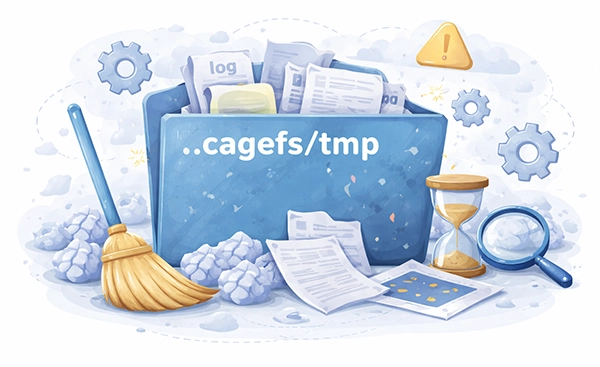
The .cagefs/tmp directory is part of the CloudLinux CageFS system, which isolates users in a secure environment. This directory is used for temporary files created by web applications running under CageFS.
The .cagefs/tmp directory serves several critical functions in the CloudLinux security architecture:
/tmp directory inside .cagefs, preventing access to other users' temporary files./tmp directory or other users' files..cagefs/tmp instead of the global /tmp./home/exampleuser/.cagefs/tmp. Inside their virtual environment, this appears as /tmp.
If a web application cannot write to .cagefs/tmp, you'll see permission errors in logs. This typically happens after incorrect manual file operations or service changes.
# Set correct ownership (replace 'username' with actual username)
sudo chown -R username:username /home/username/.cagefs/tmp

# Set secure permissions with sticky bit
sudo chmod -R 1777 /home/username/.cagefs/tmp1777 includes the sticky bit (1) which ensures users can only delete their own files, plus read/write/execute for all (777). This is standard for /tmp directories.
sudo systemctl restart cagefs
sudo systemctl restart apache2  # or httpd on CentOS
sudo systemctl restart php7.4-fpm # adjust PHP version as neededWhen .cagefs/tmp fills up, PHP sessions, file uploads, and other temporary operations will fail with disk space errors.
# Check specific user's tmp usage
du -sh /home/username/.cagefs/tmp

# Check inode usage (sometimes files are small but numerous)
find /home/username/.cagefs/tmp -type f | wc -l# Remove all files (preserves directory structure)
sudo rm -rf /home/username/.cagefs/tmp/*
# Or remove only old files (safer, preserves recent files)
sudo find /home/username/.cagefs/tmp -type f -mtime +3 -deleterm -rf command is powerful. Double-check the path before executing. Using -mtime +N to delete only old files is safer for production systems.
# Set up monitoring
df -h /home/username/.cagefs/tmp

# Consider automated cleanup via cron
# Add to crontab: 0 3 * * * find /home/username/.cagefs/tmp -type f -mtime +7 -deleteIf PHP cannot store session files, session_start() will fail, breaking user logins and sessions in web applications.
# Check current PHP session configuration
php -i | grep session.save_path

# For web server PHP, create a test file:
echo "<?php phpinfo(); ?>" > /home/username/public_html/session_test.php
# Then visit http://domain.com/session_test.php and search for session.save_path
# REMOVE this file after testing!# Edit php.ini (adjust path for your system)
# For CentOS/RHEL:
sudo nano /etc/php.ini
# For Ubuntu/Debian Apache:
sudo nano /etc/php/7.4/apache2/php.ini
# For Ubuntu/Debian PHP-FPM:
sudo nano /etc/php/7.4/fpm/php.iniFind the session.save_path line and update it to point to the user's CageFS temp directory:
session.save_path = "/home/username/.cagefs/tmp"Save the file (Ctrl+O, Enter, Ctrl+X).
sudo systemctl restart apache2  # or httpd
sudo systemctl restart php7.4-fpm # adjust versionFile uploads in PHP applications fail when the temporary upload directory is not writable or incorrectly configured.
php -i | grep upload_tmp_dir# Edit php.ini (adjust path for your system)
sudo nano /etc/php.ini # or appropriate php.ini
# Find and update upload_tmp_dir:
upload_tmp_dir = "/home/username/.cagefs/tmp"
# Also ensure these related settings are appropriate:
upload_max_filesize = 64M
post_max_size = 64M
max_file_uploads = 20upload_tmp_dir, also verify that upload_max_filesize and post_max_size are set appropriately for your application's needs.
# Test if PHP can write to the directory
sudo -u username php -r "echo is_writable('/home/username/.cagefs/tmp') ? 'Writable' : 'NOT Writable';"

# If not writable, ensure permissions are correct (as in Section 2)sudo systemctl restart apache2
sudo systemctl restart php7.4-fpm
sudo systemctl restart cagefs| Issue | Fix |
|---|---|
| "Permission Denied" in .cagefs/tmp | chmod -R 1777 /home/username/.cagefs/tmp |
| "No Space Left on Device" error | rm -rf /home/username/.cagefs/tmp/* or use find ... -mtime +N -delete |
| PHP Sessions Not Working (session_start() fails) | Set session.save_path = "/home/username/.cagefs/tmp" in php.ini |
| File Uploads Failing | Set upload_tmp_dir = "/home/username/.cagefs/tmp" in php.ini |
| Services not recognizing changes | Restart Apache/PHP-FPM: systemctl restart apache2 php7.4-fpm cagefs |
Understanding and properly configuring the .cagefs/tmp directory is essential for maintaining secure, functional web applications in CloudLinux CageFS environments!







 Telegram Bot
 USD - United States Dollar
 EUR - Euro
 GBP - British Pound
 CAD - Canadian Dollar
 CHF - Swiss Franc
 JPY - Japanese Yen
 AUD - Australian Dollar
 RUB - Russian Ruble
 TRY - Turkish Lira
 CNY - Chinese Yuan
 INR - Indian Rupee
 UAH - Ukrainian Hryvnia